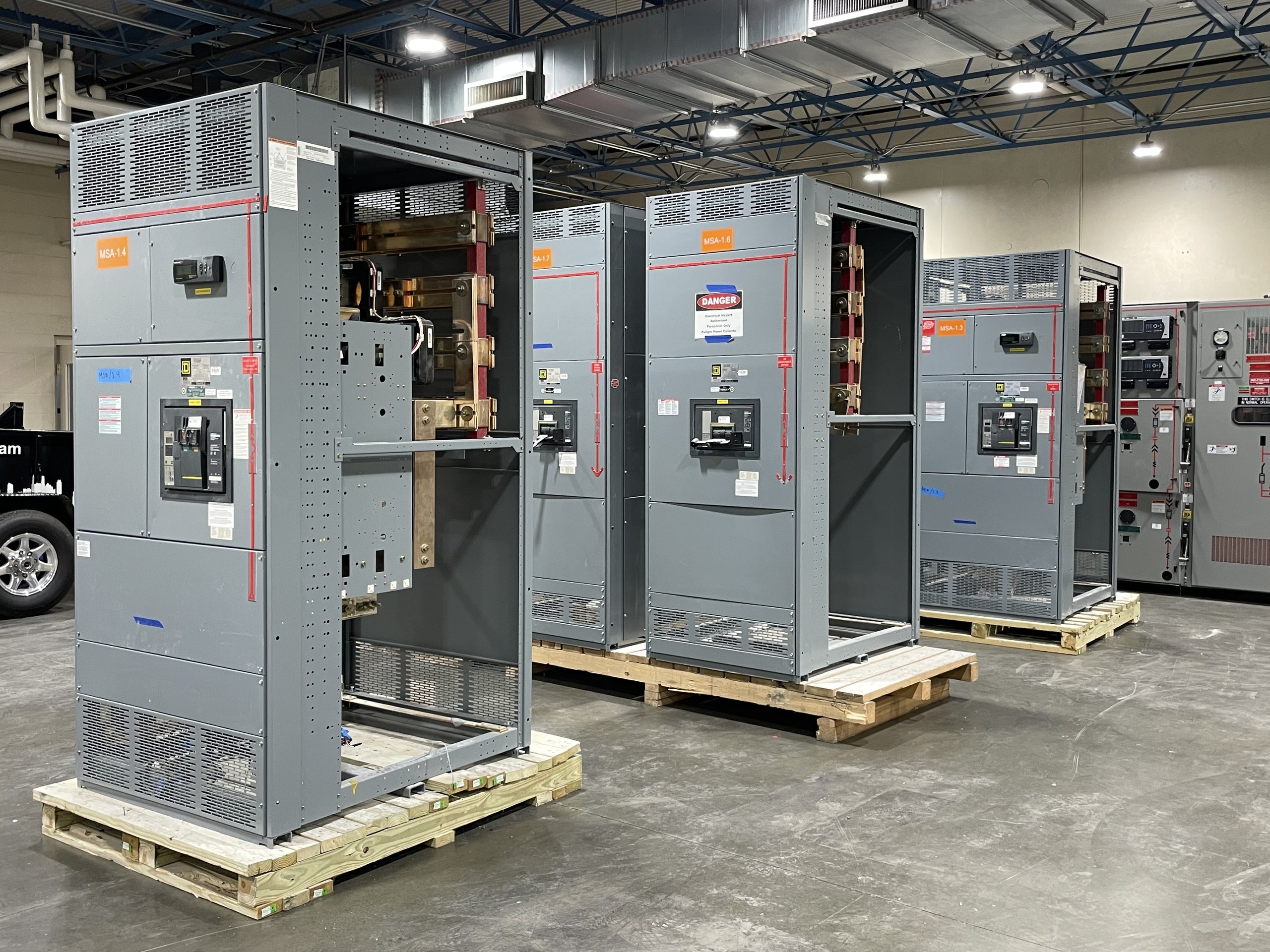
A business with switchgear or other distribution equipment in Duncan, Oklahoma, can request a review of its proposed surplus and discuss pickup directly. For example, if the lot includes electrical circuit breakers, distinguish those assets from other items and describe their actual location. We buy used, surplus and decommissioned electrical equipment; we do not sell gear. We consider all voltage classes, subject to review. For a maintenance planner cataloging retired distribution assets, the useful starting point is component identification, observed condition and records availability. Identify what is actually offered, share what is known and leave uncertain details unguessed. An offer depends on the specific equipment, condition, access and agreement between the parties.
Describe the switchgear lineup
Switchgear is generally identified as a group of protective and switching equipment, often arranged in sections. Describe the lineup as a whole, but list distinct sections and loose breakers separately when you can. Existing records or an exterior view may show the manufacturer, model, ratings and section count. A single photograph of a long lineup may not show everything included.
State whether the lineup is still installed or has already been removed, and identify any obviously absent sections or loose components. Use words such as unknown when you cannot verify a detail. A buyer needs to understand the actual scope, not assume that every compartment is complete or that a label on one breaker describes the entire lineup.
If your Duncan inventory includes electrical circuit breakers
Circuit breakers may be part of a larger lineup or offered as loose units. List each distinct manufacturer, model or catalog number, rating and quantity when known, and say whether units are installed or stored separately. An overall lineup rating should not be treated as the rating of every individual breaker inside it.
If a breaker is described as drawout, report that only when known from an existing label or record, and say whether it is installed or loose. Record visible exterior condition and missing accessories without trying to remove or operate anything. A matching name or amperage by itself does not establish compatibility with another assembly.
Catalog retired distribution assets
A maintenance planner can start with an existing equipment register and identify the retired distribution assets proposed for sale. Record the type, tag, known manufacturer and quantity, then distinguish a complete assembly from loose parts. Explain whether the gear is still installed or has already been removed without making a claim about electrical condition.
If a label or record is missing, say what is unknown and share whatever can be documented from a safe, accessible position. Maintenance history may be useful when available, but testing and disconnection are not seller requirements. Corrections to a register should be shared before the parties finalize the scope.
If relevant: Keep each site’s list separate
For a multi-site sale, create a separate equipment list for each location, with a site contact, quantities, ownership status and available release date. A shared spreadsheet can work if every line clearly identifies the property. Similar equipment at two sites should not be assumed to have the same condition, availability or handling requirements.
Describe access restrictions and any approval dependencies separately for each site. The buyer can discuss a combined or staged proposal, but neither a single submission nor a shared owner guarantees that every location or item will be accepted. Confirm the final deal and payment terms against the actual sites and assets included.
If relevant: Label the gaps in the records
Incomplete documentation does not prevent an initial discussion. Start with the equipment type, quantity, location and any manufacturer or ratings available from existing records or safely accessible exterior labels. If a drawing lacks a revision date or covers only part of a lineup, say so and identify which items it appears to describe.
Separate facts you can verify from an estimate or a previous owner's statement. If records conflict, provide both versions with a note rather than choosing one without evidence. The buyer can identify important gaps during review; sellers are not expected to open, operate, test or disconnect equipment to complete a file.
Make the inventory easy to review
Begin with one line for each assembly or clearly identifiable group. Record the equipment type, quantity, site, installed or stored status, and the manufacturer, model, voltage and amperage where known. For a lineup, say how many sections are included and distinguish loose components from installed ones. The buyer needs to know which facts describe which item.
Use existing nameplate photos, asset registers or drawings where available, and label the source of uncertain details. If a record is old or conflicts with a safely accessible exterior label, send both and explain the difference. Missing information can remain unknown; there is no reason to open equipment, approach energized gear or test it for a quote.
Set the sale scope and release date
Identify who owns the equipment and who is authorized to agree to a sale. Note any known lease, lien, retained component or approval that could limit the proposed transaction. If the equipment is on more than one property, keep each site and contact separate. A property owner's name does not automatically establish ownership of every piece of gear.
Explain whether the equipment is available now or expected after a project milestone. A tentative release date is not a scheduled pickup, and a list submitted for review is not a completed deal. If a component is later retained or an approval remains outstanding, update the buyer before finalizing the included equipment and timing.
From review to an agreed offer
This is a buying-only business; it does not sell electrical equipment. It considers used, surplus and decommissioned gear across all voltage classes, including switchgear from decommissioned data centers and shut-down power plants. A buyer reviews the actual equipment, condition, information and proposed scope before deciding whether to make an offer; no individual item is guaranteed acceptance.
If the parties agree on a deal, the buyer pays upfront before pickup. Confirm the agreed price, payment method, items included, any exclusions and timing with the authorized seller. A preliminary inquiry or estimate is not a completed transaction. Ask for clarification before accepting an offer if the proposed scope or payment terms are unclear.
Prepare the handoff, not the equipment
For an accepted deal, the buyer takes responsibility for qualified disconnects, crane, rigging, loading, freight and hauling. Sellers are not expected to test, disconnect or physically move equipment. Identify the site contact, the equipment's present location and any known access or other-work constraints that could affect coordination.
If site records include dimensions, weights or photographs, share the relevant information and explain its source. Unknowns are acceptable and can be discussed with the buyer. The actual plan and date depend on the accepted scope and site conditions; never approach energized equipment or open a cover to obtain missing details.