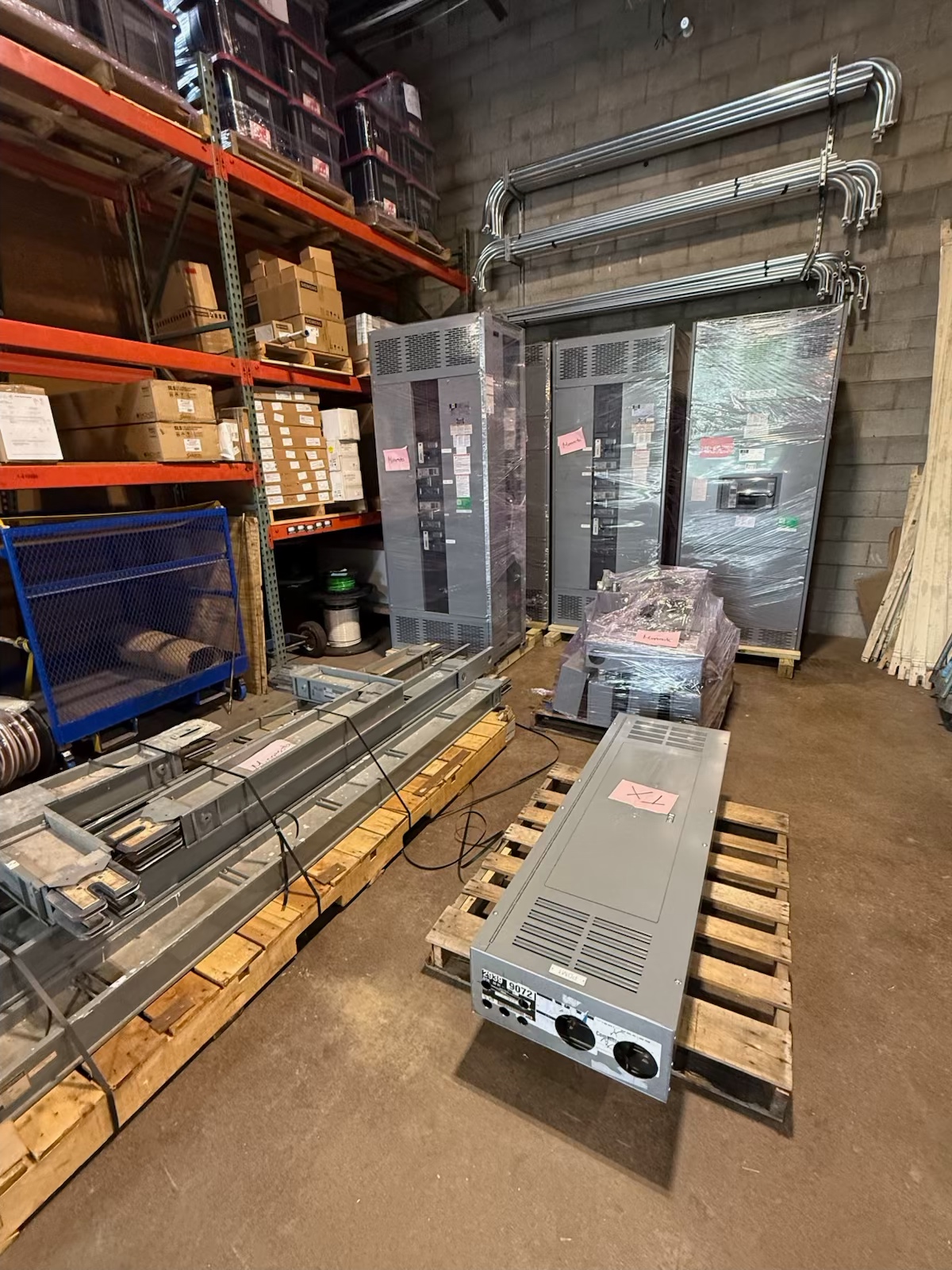
A business with switchgear or other distribution equipment in Logan County, Oklahoma, can request a review of its proposed surplus and discuss pickup directly. For example, if the lot includes electrical circuit breakers, distinguish those assets from other items and describe their actual location. We buy used, surplus and decommissioned electrical equipment; we do not sell gear. We consider all voltage classes, subject to review. For a multi-site operator coordinating equipment release, the useful starting point is location-specific lists, responsible contacts and separate schedules. Identify what is actually offered, share what is known and leave uncertain details unguessed. An offer depends on the specific equipment, condition, access and agreement between the parties.
Describe the switchgear lineup
Switchgear is generally identified as a group of protective and switching equipment, often arranged in sections. Describe the lineup as a whole, but list distinct sections and loose breakers separately when you can. Existing records or an exterior view may show the manufacturer, model, ratings and section count. A single photograph of a long lineup may not show everything included.
State whether the lineup is still installed or has already been removed, and identify any obviously absent sections or loose components. Use words such as unknown when you cannot verify a detail. A buyer needs to understand the actual scope, not assume that every compartment is complete or that a label on one breaker describes the entire lineup.
If your Logan County inventory includes electrical circuit breakers
Circuit breakers may be part of a larger lineup or offered as loose units. List each distinct manufacturer, model or catalog number, rating and quantity when known, and say whether units are installed or stored separately. An overall lineup rating should not be treated as the rating of every individual breaker inside it.
If a breaker is described as drawout, report that only when known from an existing label or record, and say whether it is installed or loose. Record visible exterior condition and missing accessories without trying to remove or operate anything. A matching name or amperage by itself does not establish compatibility with another assembly.
Keep multi-site details separate
A multi-site operator can keep one inventory per location or use a shared list with an unmistakable site field on every line. For each site, identify the equipment, quantity, authorized contact and release status. Similar-looking gear at two properties may have different owners, condition histories and availability.
Communicate actual access rules and scheduling dependencies for each location, not just a corporate address. The parties can consider a combined or staged proposal, but inclusion in a single list does not guarantee an offer on every asset. Update each site’s information as approvals or dates change.
If relevant: Identify the replaced equipment
An upgrade can leave the old and new equipment with similar descriptions. Identify the equipment being sold by its existing tag, manufacturer or location and clearly exclude the replacement and any retained spares. State whether the old equipment is still installed, already removed or expected to be released later.
An existing project schedule may help communicate availability, but dates can change as work proceeds. Mark tentative dates and identify the authorized site contact. The seller need not disconnect or test the equipment; after an accepted deal the buyer handles qualified disconnects and the agreed physical logistics.
If relevant: Show what remains in the lineup
An incomplete lineup is not necessarily a single, uniform item. List the sections that are present, any known missing section, and which breakers or other components are loose, installed, retained or unknown. Give each section an identifier from existing records or a safely accessible exterior label; do not try to open compartments to fill gaps.
Explain whether the missing pieces were removed before the current owner acquired the gear or whether the history is unknown. If the seller wants to retain any sections, mark them as excluded. A buyer can review an incomplete lineup, but completeness, condition and the actual sale scope influence whether an offer is possible.
Record facts and unknowns separately
A practical equipment list can be short: type, quantity, location, any known manufacturer and ratings, and whether the item is still installed or stored. Add section counts or related loose items where relevant. The same manufacturer may appear on several distinct assemblies, so match labels and records to the right line rather than combining unlike items.
Note visible exterior damage, missing components and the limits of the available history. Do not claim a device works simply because its exterior looks intact. Existing documentation and safely accessible photos help a buyer review the inventory, but a seller is never asked to open, operate or test equipment for this request.
Confirm who can release the assets
A clear proposal identifies the authorized seller, the specific items offered and any parts that are not included. Different owners, tenants, contractors or lenders may have an interest in different assets, so disclose known restrictions and approval requirements. Use a separate entry for each site or equipment group when authority or availability differs.
State whether items are still installed, already removed or stored, and provide your best known release window as an estimate. Other project work can affect the handoff. Both sides should agree on the actual scope and schedule rather than assuming that a preliminary inventory or a hoped-for date is final.
From review to an agreed offer
This is a buying-only business; it does not sell electrical equipment. It considers used, surplus and decommissioned gear across all voltage classes, including switchgear from decommissioned data centers and shut-down power plants. A buyer reviews the actual equipment, condition, information and proposed scope before deciding whether to make an offer; no individual item is guaranteed acceptance.
If the parties agree on a deal, the buyer pays upfront before pickup. Confirm the agreed price, payment method, items included, any exclusions and timing with the authorized seller. A preliminary inquiry or estimate is not a completed transaction. Ask for clarification before accepting an offer if the proposed scope or payment terms are unclear.
Prepare the handoff, not the equipment
For an accepted deal, the buyer takes responsibility for qualified disconnects, crane, rigging, loading, freight and hauling. Sellers are not expected to test, disconnect or physically move equipment. Identify the site contact, the equipment's present location and any known access or other-work constraints that could affect coordination.
If site records include dimensions, weights or photographs, share the relevant information and explain its source. Unknowns are acceptable and can be discussed with the buyer. The actual plan and date depend on the accepted scope and site conditions; never approach energized equipment or open a cover to obtain missing details.